
Gauteng Tables R179.2 Billion Budget to Strengthen Service Delivery and Economic Growth
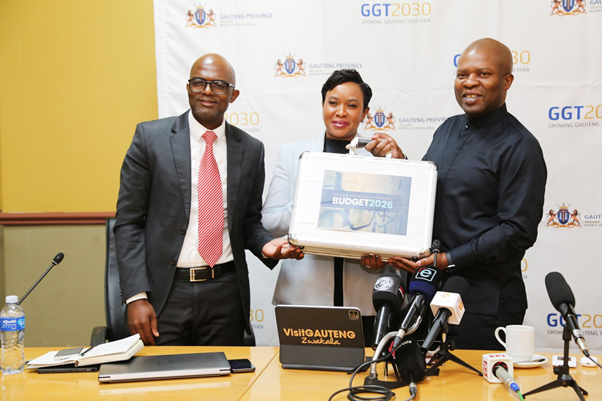
The Gauteng Provincial Government has tabled a R179.2 billion provincial budget for the 2026/2027 financial year, aimed at improving service delivery, strengthening infrastructure development and stimulating economic growth across the province.
The budget was presented by Lebogang Maile, Member of the Executive Council (MEC) for Finance and Economic Development in Gauteng, under the theme “The audacity of hope: A collective commitment to building a resilient Gauteng.”
The theme aligns with the observance of Human Rights Month in South Africa, which focuses on advancing constitutional democracy and ensuring that the rights enshrined in the country’s Constitution translate into tangible improvements in the daily lives of citizens.
According to Maile, the budget reflects government’s determination to confront economic challenges while prioritising service delivery and social development.
“The audacity of hope is about the courageous and stubborn refusal to succumb to cynicism, despair or fear in the face of daunting challenges,” he said during the budget presentation.
Economic Outlook Signals Gradual Recovery
Despite global and domestic economic pressures, Gauteng remains the economic engine of South Africa, with a provincial Gross Domestic Product by Region (GDP-R) exceeding R2.4 trillion.
Economic projections indicate that the provincial economy is expected to grow by 2.1 percent in 2026, outperforming the national growth forecast of 1.6 percent.
The province has also recorded notable employment gains. During 2025 alone, more than 250 000 jobs were created, including 95 000 jobs in the second quarter, the highest recorded by a single province during that period. Currently, more than six million people are employed in Gauteng, with the majority being youth and women.
Sectors such as trade and construction were among the strongest contributors to job creation.
However, Maile emphasised that more work remains to ensure inclusive economic growth, particularly for historically disadvantaged communities.
Gauteng Investment Conference Attracts Billions
Government’s growth strategy also centres on re-industrialisation and integrating township enterprises into the mainstream economy.
This vision was reinforced through the inaugural Gauteng Investment Conference held in April 2025, which attracted over 1 800 delegates and secured R312.5 billion in investment pledges.
By February 2026, 28 percent of the pledged investments had already been converted into active projects, with 18 projects valued at over R80 billion currently in the rollout phase.
Provincial officials believe these investments will significantly contribute to job creation and economic expansion in the coming years.
R36.4 Billion Infrastructure Programme
Infrastructure development remains central to the province’s economic strategy.
Over the 2026 Medium-Term Expenditure Framework (MTEF), government has allocated R36.4 billion towards infrastructure programmes.
Of this amount:
- R26.2 billion comes from conditional grants
- R10.2 billion comes from the provincial equitable share
Major beneficiary departments include Health, Education, Human Settlements and Roads and Transport, which together receive R34.4 billion.
The infrastructure funding will focus on:
- Expanding existing facilities to meet growing service demand
- Maintaining and upgrading aging infrastructure
- Supporting economic activity through improved transport and service networks
Government also urged communities to protect public infrastructure against vandalism and sabotage, which continue to undermine service delivery.
Public-Private Partnerships to Accelerate Development
In a constrained fiscal environment, the province plans to increase reliance on Public-Private Partnerships (PPPs) to deliver key infrastructure projects.
One prominent example is the Gautrain rapid rail system. The current concession agreement is set to expire in March 2026, after which the province will appoint a new operator to manage and modernise the system under a renewed PPP arrangement.
By the end of the concession period, the Gautrain will become a fully paid-up state asset valued at approximately R45 billion, strengthening the province’s strategic transport infrastructure.
Other projects under consideration for PPP delivery include:
- The Gauteng Provincial Network
- A Provincial Data Centre
- Scholar transport systems
Major Departmental Budget Allocations
The provincial government will spend R549.3 billion over the next three years, with the following allocations planned:
Social Services
Social sector departments receive the largest share of funding.
- Health: R70.3 billion in 2026/27 (R218.6 billion over MTEF) to strengthen healthcare services, improve maternal and child health, and expand emergency medical response.
- Education: R70.9 billion in 2026/27 (R221.8 billion over MTEF) to improve early childhood development, learner performance programmes, school safety and inclusive education.
- Social Development: R5.6 billion in 2026/27 to support poverty alleviation programmes, homelessness initiatives and substance abuse treatment services.
Economic Development and Infrastructure
- Economic Development: R1.8 billion to support Special Economic Zones and enterprise development.
- Human Settlements: R5.5 billion for housing delivery and informal settlement upgrades.
- Roads and Transport: R10.2 billion to improve transport infrastructure and strategic road networks.
Safety and Governance
- Community Safety: R2.3 billion to enhance policing oversight, road safety and efforts to combat gender-based violence.
- Cooperative Governance and Traditional Affairs: R680.5 million for disaster management and municipal support.
Digital Transformation and Environment
- e-Government: R1.9 billion to expand township Wi-Fi hotspots and CCTV infrastructure.
- Environment: R646.6 million to strengthen air quality monitoring and waste management infrastructure.
Fiscal Pressures Remain
Despite the ambitious spending plans, the province faces significant financial constraints.
Among the key obligations is the e-toll debt, where government has already paid R9.3 billion toward the R20 billion principal amount. A further R4.6 billion payment is due in June 2026, with R6.2 billion still payable during the remaining MTEF period.
These obligations limit fiscal flexibility and place pressure on provincial finances.
Focus on Human Dignity and Inclusive Growth
In closing his address, Maile emphasised that the budget aims to protect frontline services while improving accountability and financial discipline.
Social sector spending — covering health, education and social development — accounts for approximately 83 percent of the provincial budget, highlighting government’s focus on improving living conditions for residents.
“This budget is sensitive to the lived realities of our constituencies,” Maile said.
“It is a budget aimed at uplifting human dignity, restoring law and order, and protecting the most vulnerable members of society.”
INFO SUPPLIED.